

Behind every black belt lies a journey far deeper than the mastery of technique — a path of transformation, symbolism, and inner rebirth. In this illuminating essay, Paolo N. Corallini explores the esoteric meaning of Aikido’s dan grades, revealing how each step — from Shodan to Judan — reflects not just progress in skill, but an alchemical evolution of body, mind, and spirit. Through the language of numbers, elements, and universal archetypes, this text uncovers the hidden grammar of the martial path, showing how true advancement in Aikido is measured not by power or rank, but by harmony, awareness, and the quiet maturity of the heart.
by PAOLO N. CORALLINI

SHODAN
Marks the real beginning of the study of Aikido. It is the apprentice’s grade—not, as is often misunderstood, the level of mastery. It is the first step on this splendid initiatory path.
This grade is characterized by the authorization to wear the black belt and the hakama. In an alchemical sense, the black color of the belt and the hakama expresses the nigredo, the regressus ad uterum—a death to profane life prior to rebirth into the initiatory life.
Wearing the hakama means one is now devoted, body and soul, to the Way of Aiki. It is a true charge in the chivalric sense of the term. The yudansha is a person to whom responsibilities can be entrusted, someone you can count on both in the dōjō and outside it.
Being permitted to wear the hakama is a sign of trust—evidence that the elders accept you as worthy to receive more reserved teachings.
It is therefore an initiation in the most traditional sense. The number one indicates the human being standing upright—the only living creature endowed with this faculty. This number represents the active human, associated with the work of creation and linked to the Principle, the Creator God, the One, the source of all things, the cosmic center.
It symbolizes not only being, but also gratitude, which mediates elevation through knowledge, raising the human being to a higher level.
NIDAN
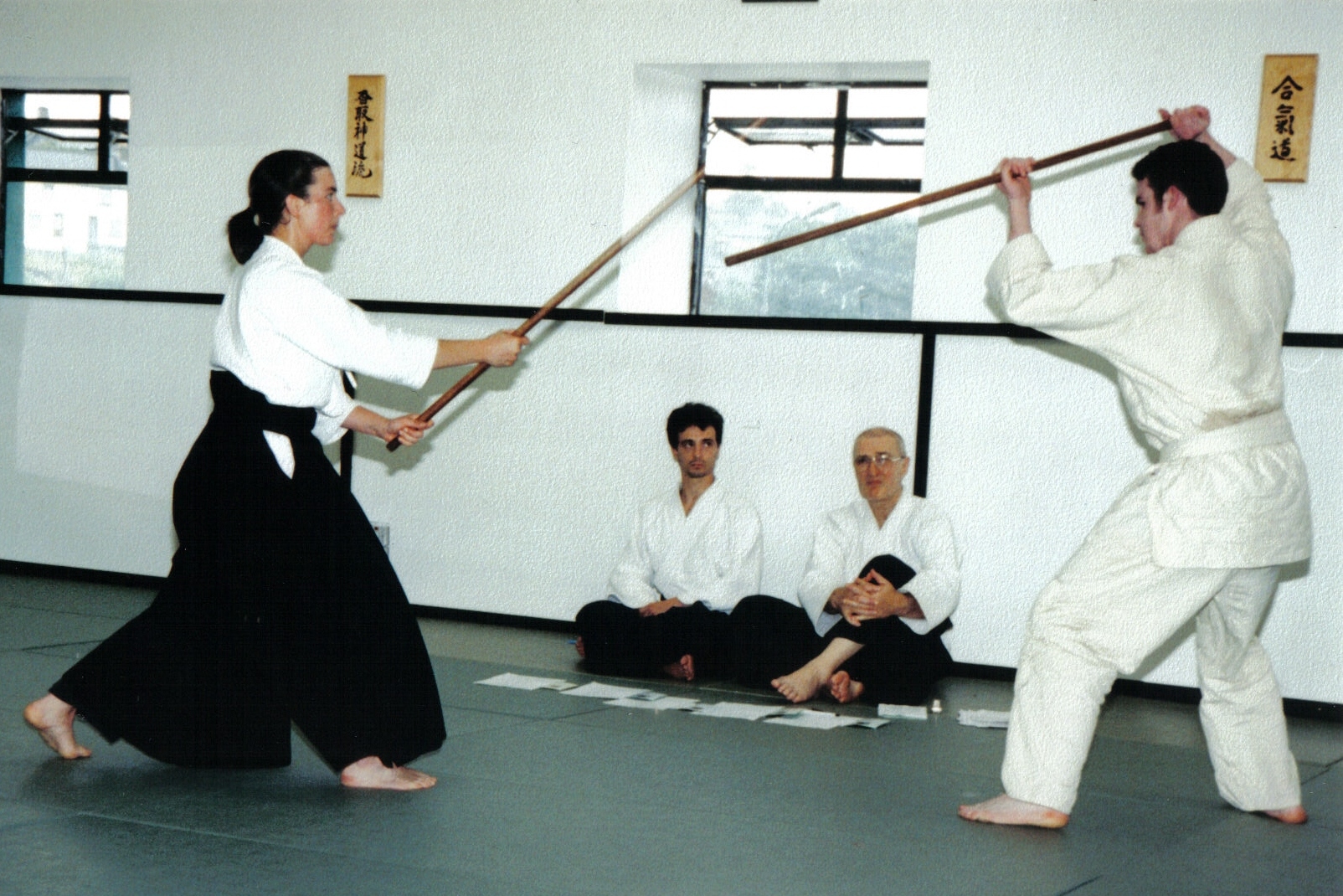
Usually obtained after at least two years of steady practice, it marks an important stage in the initiatory journey. At this grade the initiate has worked assiduously on the basic principles and has learned that the foundations of any structure must be solid—kotai (kihon waza).
The symbolism of the number two—always an expression of equality and opposition—indicates reflection and balance, and suits this grade well, since the initiate now has a vision of what is and what must not be. One now distinguishes omote from ura, irimi from tenkan, positive from negative, high from low.
Two is the number linked to the feminine principle, synonymous with manifestation, as it produces existence and being, and thus becomes the cause of duality that emerges when objectivity is present (and disappears when the formal aspect fades). Two, in short, originates form–matter.
One must know complementary opposites—the world of dualism—in order to understand the whole.atter. To comprehend the whole, one must first understand the world of opposites.
SANDAN
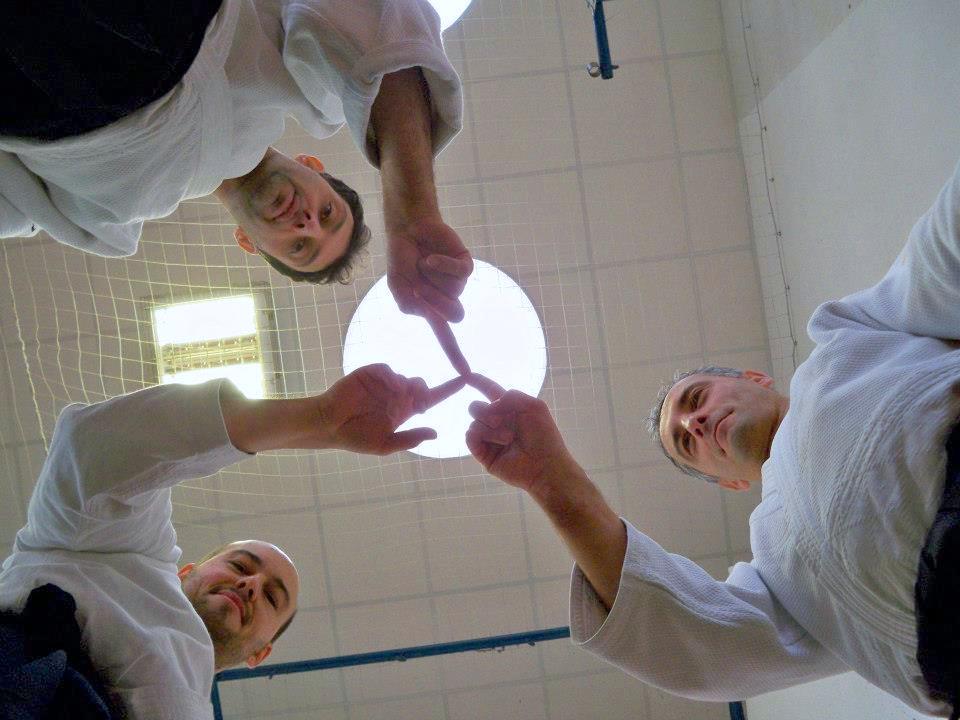
Obtained after an intense period of practice of at least three years.
According to the Founder of Aikido, this was the level up to which one should study only kihon waza. At this point the initiate has come to know the earth element—has an idea of the material world that will be fully grasped at the next grade.
The number three is the number of perfection, proper to the gods. It expresses completeness, realization, intellectual and spiritual order. This sacred number synthesizes the triple unity of the living being, in which the union of heaven and earth takes place.
It is the expression of totality, of fulfillment. Three are the times of the manifest—past, present, and future—and three are the elements of the Great Alchemical Work: sulfur (spirit), salt (body), and mercury (soul).
At this grade, one has traversed (in the past) the earth element, represented by the solid foundations of practice; (in the present) one matures technical awareness and the skill needed to face, in the future and with ease, the water element. The initiate at this grade strengthens the spirit, now masters the body, and gradually learns to know the universal soul, preparing to realize in the near future the alchemical marriage of the Great Work—what Ō-Sensei called Shin Gi Tai Ichi (spirit, body, soul—one thing).
YONDAN
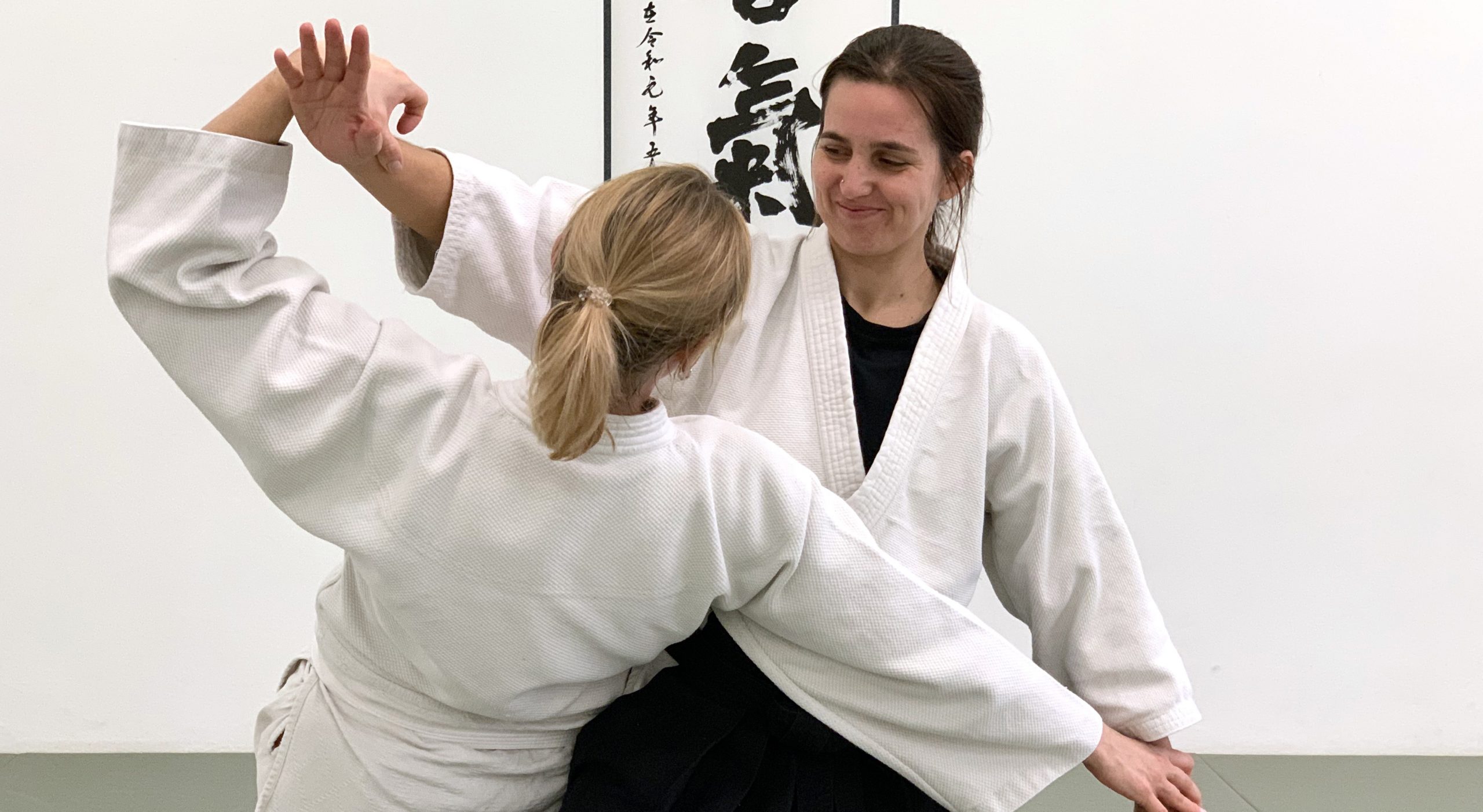
This is the beginning of practice beyond basic technique. One now knows sufficiently well the quaternity—the manifest, visible world. Forms that were formerly static are now in motion (Ki no Nagare Waza); the fluidity typical of the water element dominates this grade.
The number four indicates awareness, concreteness, universality, totality. It connects with the symbols of the square and the cross, and recalls the four cardinal points, the four seasons, the lunar phases, the four elements, and so on.
The initiate now knows how to orient themselves in the complex and marvelous world of Aiki, respects the universal laws of nature, and moves free from material constraints; thanks to the faculties now attained, the journey through the elements can continue.
Referring to the symbolism of the cross, the number four calls us to the sense of rectitude and justice—qualities proper to those who have trodden a spiritual Way seriously and deeply.
At this level, one also evaluates certain virtues acquired over many years of steady practice: loyalty, courage, fidelity, precision, tenacity, and integrity.
GODAN
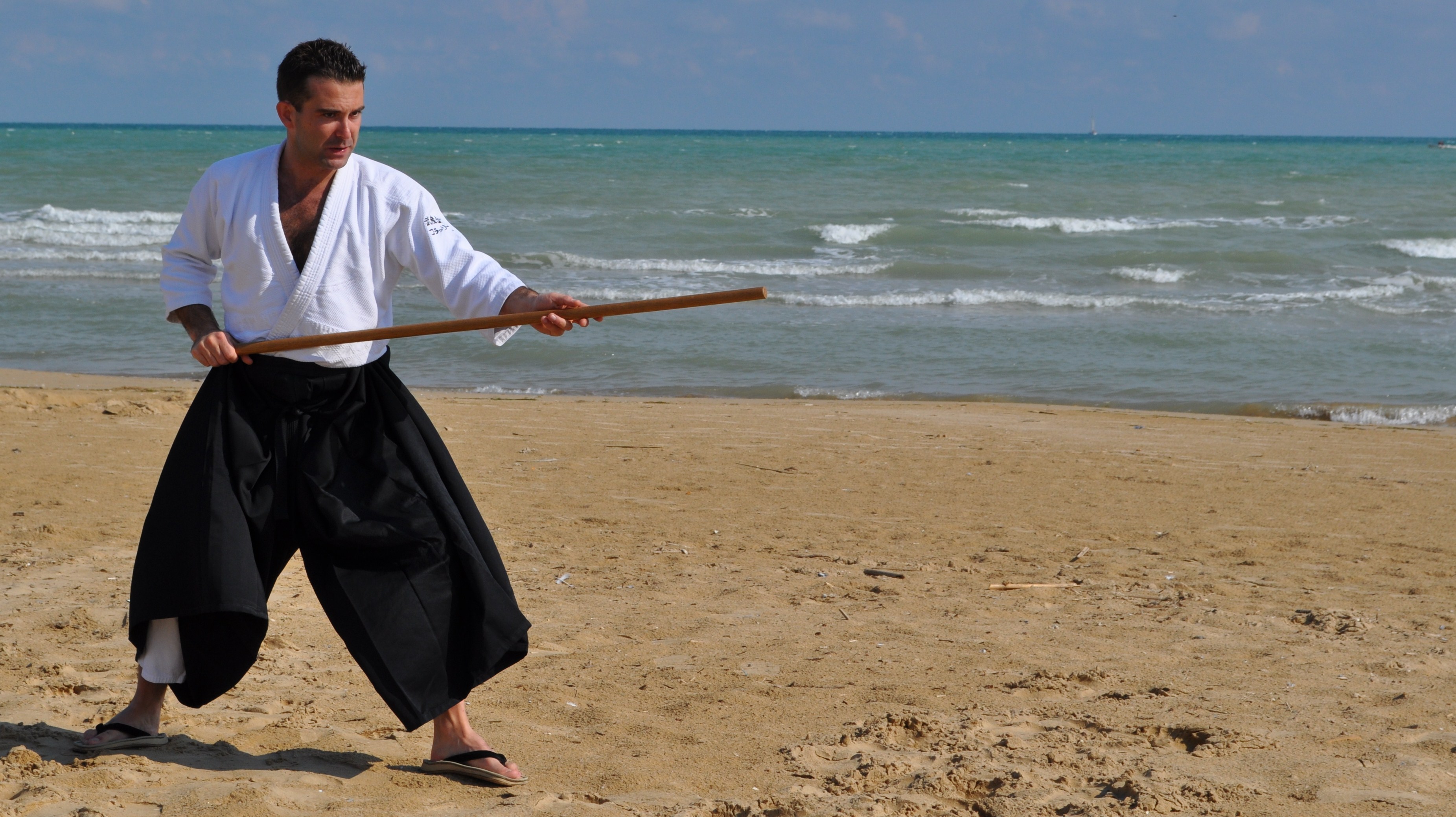
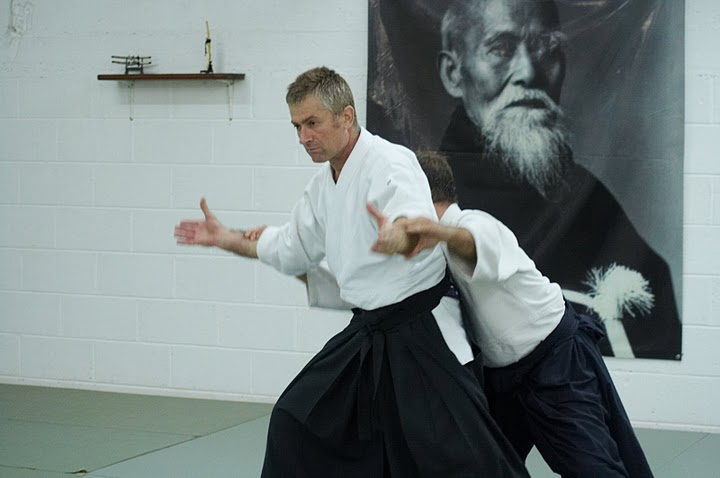
Generally awarded honoris causa (suisenjo), typically after a minimum of five years. The number five, composed of two (earthly) and three (heavenly), signifies unity and harmony between heaven and earth — the balance of opposites.
It represents the fusion of spirit and matter, of the visible and invisible. The initiate who reaches this level has mastered the four elements and begins to perceive the essence — the One.
Five embodies both solar and lunar qualities: intuition, strength, character, sensitivity, and flexibility. At this level, the practitioner moves within the element of air.
The five-pointed star symbolizes the initiated human — arms open, inscribed within the pentagram. Its center, the heart, sustains life. As the Founder of Aikido often said: “Aikido is a matter of the heart.”
ROKUDAN
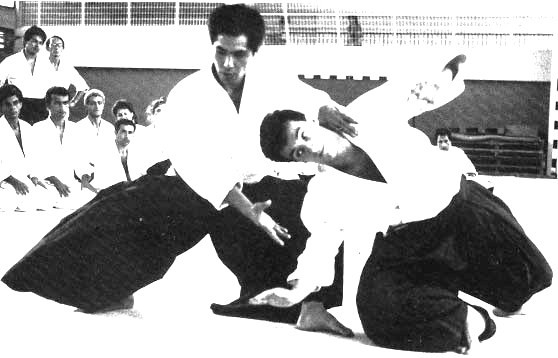
Bestowed for special merits and conferred upon people of high technical level and uncommon moral qualities. Normally it can be received after a minimum period of six years following Godan. At this minimal level one may be awarded the title of Shihan, meaning “a person to imitate” or “the one who indicates the Way.”
In some Budō, at this level, one may wear the white hakama—a symbol of purity and spiritual elevation—and the red-and-white belt.
Six is formed by two times three; it is therefore a symbol of balance, perfection, and the capacity to rise from the particular to the universal. Six is the number of reciprocal gifts, of antagonisms that find in the initiate at this grade perfection in potency. Six represents initiation through the hardest trials—the equilibrium between opposites.
At this level the candidate has enough wisdom and experience to discern between good and evil. Six are the faces of the cube—the square in motion—symbol of manifestation. For Vitruvius, six were the rules and reflections of divine creation.
Six represents the four cardinal points plus the zenith and the nadir—the orientations of the visible creation. In the divine realm, this number is the science of good and evil; in the intellectual realm, the balance between the universal law and human freedom; and in the physical plane, the antagonism of natural forces. The number evokes the hexagram—two interlaced equilateral triangles. Six expresses the harmonious union of two natures: the divine and the human.
In Indian philosophy (which, as we know, partly influenced the birth of Budō in the Far East) one speaks of six veils (skin, flesh, bones, blood, nerves, marrow); six enemies (desire, anger, greed, folly, pride, envy); six conditions (conception, individuation, growth, maturity, decline, destruction); six waves (hunger, thirst, sorrow, madness, old age, death). The initiate at this grade moves in balance and harmony among these entities, unscathed by the negative valences of each. They fully know the Air element and soar lightly within it.
NANADAN (or SHICHIDAN)
May be received after a minimum period of twelve years following Rokudan, and is granted very rarely and only to truly selected people.
Seven is par excellence the magical number of mastery in many initiatory schools. It is a symbol of steadfastness and a sign of the existence of God.
Seven is composed of three (symbol of divinity) and four (symbol of the universality of created things). It is thus the symbol of the indissoluble union of the two worlds—spiritual and physical.
By extension, one may understand seven as the union of heaven and earth—the expression of a universe in motion. The initiate at this level begins to feel the sacred fire burn in their athanor, the hara tanden. The person who reaches this grade should have attained a high level of perfection, having knowledge of the material world and of divine principles.
HACHIDAN
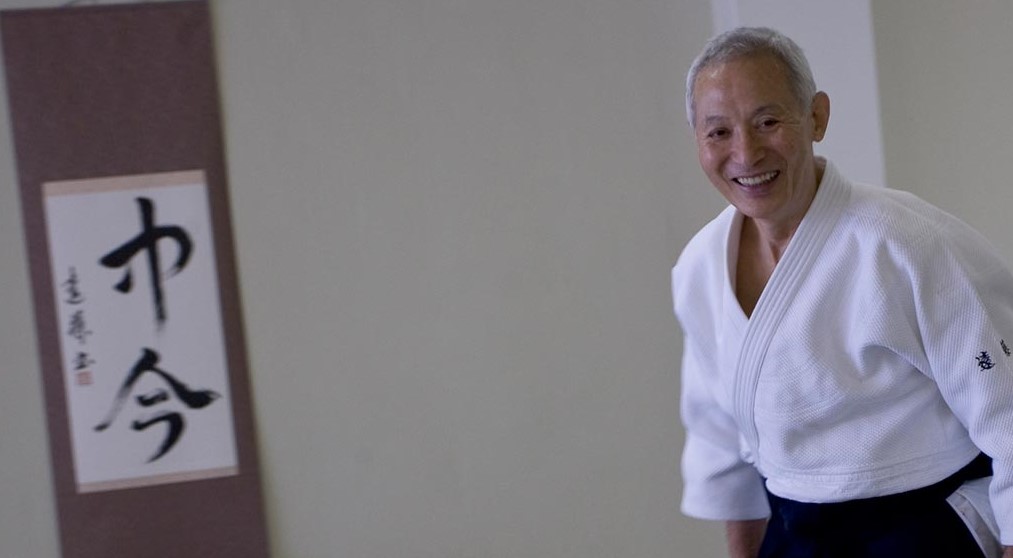
An honorary grade very rarely conferred by the Aikikai Foundation. It is a recognition reserved for people of high technical and moral value and for leaders who have founded and who lead Aikikai organizations in foreign countries. At this level, what the candidate has done and is doing for the development of Aikido in the world—and the competence with which this task is carried out—is taken into account.
The number eight results from the optimal combination of 4 + 4, so its symbolism is linked to the value of dualism. This number recalls the Compass Rose with its four cardinal points and four intercardinal points, expressing the ability to orient oneself in every direction thanks to acquired knowledge. Eight is the symbol of Infinity, of cosmic balance.
The term “Compass Rose” was borrowed from the Wheel of the World, which represents the material world (the square) in motion within the circle, symbol of the Universe.
In many temples one finds eight columns resting on a square base supporting a round dome—thus realizing the squaring of the circle.
From the unity of the celestial vault to the square of the earthly elements, one passes through the octagon, which relates to the intermediate world of the eight directions, eight gates, and eight winds—those that will fan the flames now released by the initiate’s athanor at this grade.
Eight expresses the divine in the human; it is the link between opposites, between ascent and descent, between the superior and the inferior, between God and the human being. Eight indicates the way of the just.
KUDAN
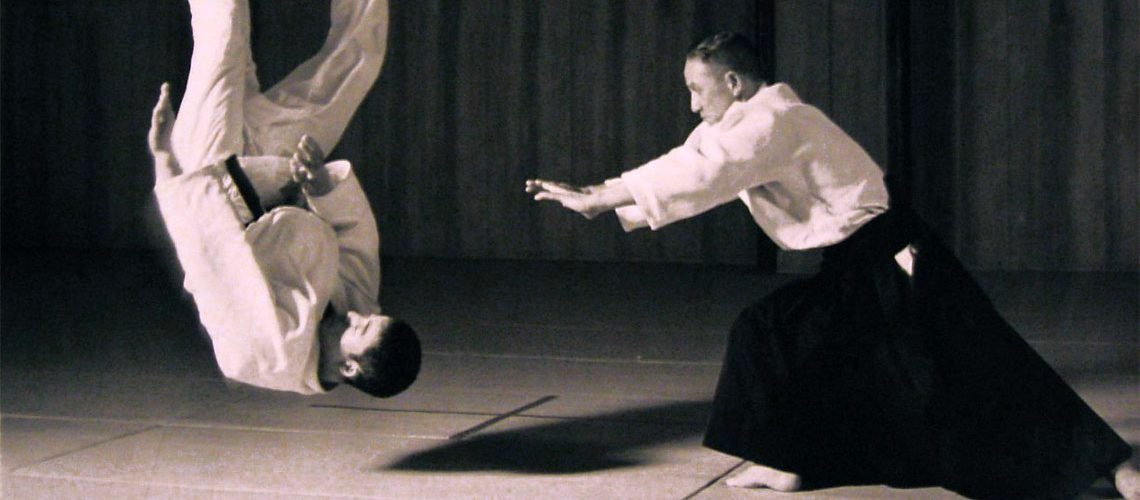
A grade reached only by very few masters who have held a pre-eminent place in the history of Aikido—figures truly enlightened and in possession of profound knowledge.
Nine is considered the most important magical number, that which distinguishes the true initiate at the higher levels; it indicates stability, order, absolute wisdom, prudence, and circumspection in action. One may add that, while nine confers completion on a human creation, it also symbolizes success in research and the crowning of efforts. This number is a symbol of perfection as the result of three triads.
The combination 3 + 3 + 3 = 9 often recurs in the esoteric doctrines of many peoples of the world, serving a cosmological function: each world is depicted as a triangle, a ternary figure (Heaven, Earth, Underworld); therefore nine expresses the totality of the three worlds.
The ancient Egyptians mention this number in relation to the Mountain of the Sun, recalling the evolution of the three worlds—divine, natural, and intellectual—in relation to the trinitarian archetype Osiris–Isis–Horus, representing essence, substance, and life.
The Founder of Aikido spoke of his Art by comparing it to a pyramid divided into four ascending levels: kotai, jutai, ryūtai, kitai (solid, flexible, fluid, spiritual), finally crowned by the Light of Knowledge, the world where the Initiated Human, now free, can be reunited with God.
JUDAN
An extremely rare grade; it seems the Founder conferred it probably only once or twice.
The ideogram for this number is a cross 十 (jū)—the union of the vertical and the horizontal line intersecting symmetrically to indicate the balance between Heaven and Earth.
The vertical line is the channel through which cosmic energies descend and telluric energies ascend; it expresses the human vertical axis (the spine) understood as the axis mundi.
The horizontal line symbolizes communication on the plane of human–earthly manifestations—horizontality. The vertical line is a symbol of rectitude; the horizontal is a symbol of equity. Thus this number confers upon those who hold it the sense of the upright and just person—one who, now purified, becomes a bridge (pontifex) between Heaven and Earth, between the divine and the human.
The number ten is the sum of 1 + 2 + 3 + 4, and therefore gathers all the symbolic values expressed by those individual numbers. Hence it is a perfect number, representing the completeness of creation which, in spatial and temporal terms, extends from the beginning to the end, constituting a cycle of manifestation—existence in its entirety.
In every religious and philosophical doctrine, the number ten has always been linked to concepts of sacredness, totality, and perfection. It suffices to recall the Ten Commandments, the ten principal Egyptian divinities, the ten Sefirot of the Kabbalah, etc.
According to Kabbalists of all schools, divine power emerges from its hidden life and manifests in ten spheres—the Sefirot—which constitute the unity and synthesis of the universe.
The Sefirot suggest an additional combination of the number ten, namely 3 + 7.
The first three superior Sefirot identify with Crown, Wisdom, and Understanding, while the other seven inferior ones with Love, Beauty, Eternity, Glory, Foundation, Strength, and the Visible Presence.
Copyright Paolo N. Corallini
All rights reserved. Any unauthorized reproduction is strictly prohibited
This article is published thanks to the kind concession of Paolo N. Corallini.

Raj Soren: The Black Belt Mindset
for Life and Business
The Ran Network – The Budo Classics N. 7
Embark on a transformative journey with award-winning martial artist, mindset business and stress coach Raj Soren in The Black Belt Mindset. With over 40 years of experience across multiple martial arts disciplines, Soren reveals how the principles of martial arts can profoundly impact both personal and professional success, providing timeless lessons for navigating life’s challenges.
Through powerful stories and insights from inspirational martial artists, Soren explores the lessons of discipline, resilience, and self-mastery gained from practices like Jiu-Jitsu, Aikido, Kung Fu, Krav Maga, Karate, Kickboxing, Tai Chi, and Brazilian Jiu-Jitsu. These arts have shaped the character, mindset, and approach to life of not only Soren but countless others, offering practical tools for overcoming adversity, embracing growth, and achieving success in life and business.
At the heart of the Black Belt Mindset are key Japanese philosophies that amplify personal and professional development:
- Ikigai: Finding your purpose and aligning your life and work with your passion, mission, and values.
- Kaizen: Embracing continuous improvement, both in business and personal life, by making incremental but impactful changes.
- Kintsugi: Learning to embrace imperfections and setbacks, transforming them into strengths.
- Hara Hachibu: Practising self-discipline and moderation, learning the art of balance and avoiding burnout.
- Shoshin: Cultivating a beginner’s mindset, staying curious and open to learning throughout life’s journey.
- Wabi-sabi: Finding beauty in imperfection and the value in life’s fleeting, imperfect moments.
More than just a memoir, “The Black Belt Mindset” is a guide to harnessing these timeless principles, helping you develop strength, focus, and resilience. Whether you’re a martial artist or simply seeking inspiration, Soren’s insights will empower you to approach life with clarity, determination, and confidence.
This is not just a path for martial artists, but for anyone who wants to elevate their personal and professional lives. Your journey towards lasting success and growth begins here.
 Aikido Italia Network
[…] Corallini Paolo, Dan Grades – A Symbolic Perspective https://simonechierchini.com/2020/05/15/dan-grades-a-symbolic-perspective/ (Retrieved […]